The FIFA World Cup is the ultimate global spectacle, and long before the first match kicks off, the world holds its breath for a crucial moment: the group stage draw. It is a ceremony full of suspense and endless possibilities, where the destinies of 48 nations are shaped by the chance of the draw. Will your favorite team find a clear path to the Round of 16, or will they be grouped into a dreaded “Group of Death”?
You don’t have to wait for the official event to find out. THE 2026 World Cup Draw Simulator is your personal playground to explore every simulation scenario imaginable. This is a powerful tool that allows you to make your own draws, understand the new tournament format and visualize the path to glory.
This comprehensive guide will walk you through everything you need to know to master the simulator, from drawing basics to advanced strategies for analyzing results.
Ready to take control and shape your own World Cup?
What is a 2026 World Cup Draw Simulator?
A 2026 World Cup Draw Simulator is an interactive tool that meticulously recreates the official FIFA draw process. It’s not just a random name generator; it uses the same team pots, follows the same complex rules and adheres to the same geographic constraints as the real ceremony. This ensures that each group stage scenario produced is a valid and plausible outcome for the tournament itself.
For football fans, the simulator is an essential tool for:
- Understanding the drawing process: Demystify the complex rules of the 48-team format by seeing them in action.
- Explore “What if” scenarios: Instantly generate hundreds of different group combinations to see your team’s best and worst draws.
- Fuel debates and create content: Settle arguments with friends on the ultimate “Group of Death” or generate unique media for your blog, social media or YouTube channel.
- Experience the excitement: Feel the thrill of the draw, anytime, right from your computer or phone.
The Biggest Change in History: Understanding the 48-Team Format
The 2026 World Cup is revolutionary. For the first time, the tournament goes from 32 to 48 teamscompletely reshaping the path to the finale. Before using the simulator, it is essential to understand the new rules by which it operates.
For a full breakdown, you can read our detailed guide to the World Cup group stage and draw processbut here are the main changes:
1. Seedling pots
The 48 qualified nations are divided into four hats, each containing 12 teams. This ranking is based on the official FIFA World Rankings published in the months preceding the draw.
- Jar 1: Contains the three host nations (United States, Canada, Mexico) and the 9 highest ranked qualified teams. They are the top seeds of the tournament.
- Jar 2: Contains the following top 12 teams according to the FIFA rankings.
- Jar 3: Contains the next 12 teams.
- Jar 4: Contains the final 12 teams, including the lowest ranked nations and the winners of the interconfederation qualifiers.
You can check the latest team ranking predictions on our 2026 World Cup pots page.
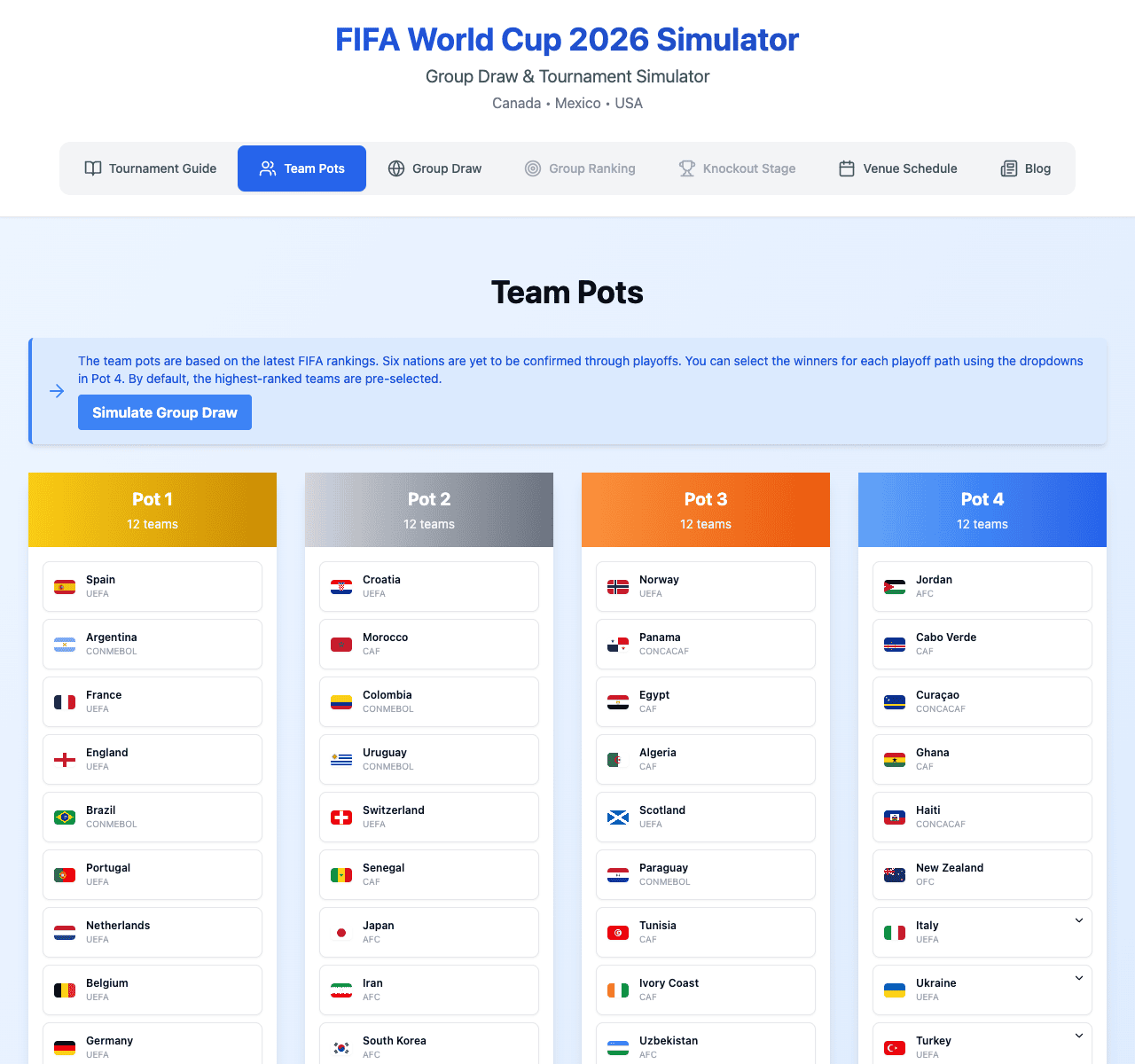
The 48 teams are divided into four pots, guaranteeing a balanced and competitive draw.
2. Groups: 12 Battle Arenas
The teams will be divided into 12 groups of 4 teams each (Groups A to L). The basic rule is that each group will contain exactly one team from each of the four pots. This prevents the strongest teams from all being grouped into one group.
3. The most important drawing constraints
This is where the real complexity comes in and what makes a high-quality simulator so valuable. The draw is not completely random; it must follow specific rules to guarantee geographic diversity and competitive balance.
- Placement in the host country: The three host countries are pre-assigned to specific groups to ensure they play their group stage matches at home.
- No clashes between Confederations: With one exception, teams from the same continental confederation cannot be drawn into the same group. For example, Brazil (CONMEBOL) cannot be in a group with another South American team like Colombia.
- The European rule: Europe (UEFA) has 16 teams in the tournament, more than the number of groups. Therefore, a maximum of two European teams are allowed in any group.
OUR 2026 World Cup Draw Simulator automatically handles all of these complex rules in the background, so you can be sure that every result you generate is a realistic possibility.
How to Use the World Cup Draw Simulator: A Step-by-Step Guide
Ready to become master of your own destiny in the World Cup? It’s simple, quick and incredibly fun.
Step 1: Access the drawing simulator
First of all, go to official drawing simulation page. Here you will find the teams carefully organized in their four pots, as they would be during the official ceremony.
Step 2: Click “Simulate Drawing”
This is where the magic happens. With just one click, our simulator’s powerful engine instantly executes the entire drawing procedure. It pulls one team at a time from each pot and places them into groups, while respecting all real-time FIFA constraints.
Step 3: Analyze your results
In a few seconds, you will have in front of you a complete tournament bracket of 12 groups and 48 teams. Now the real analysis begins. Browse the groups to find:
- The group of death: Is there a group with three or even four world-class teams?
- Your team’s journey: Who did your nation draw? Is this a dream path to the knockout stages or a nightmare scenario?
- Intriguing confrontations: Have historic rivals reunited? Are there any can’t-miss David vs. Goliath stories waiting to unfold?
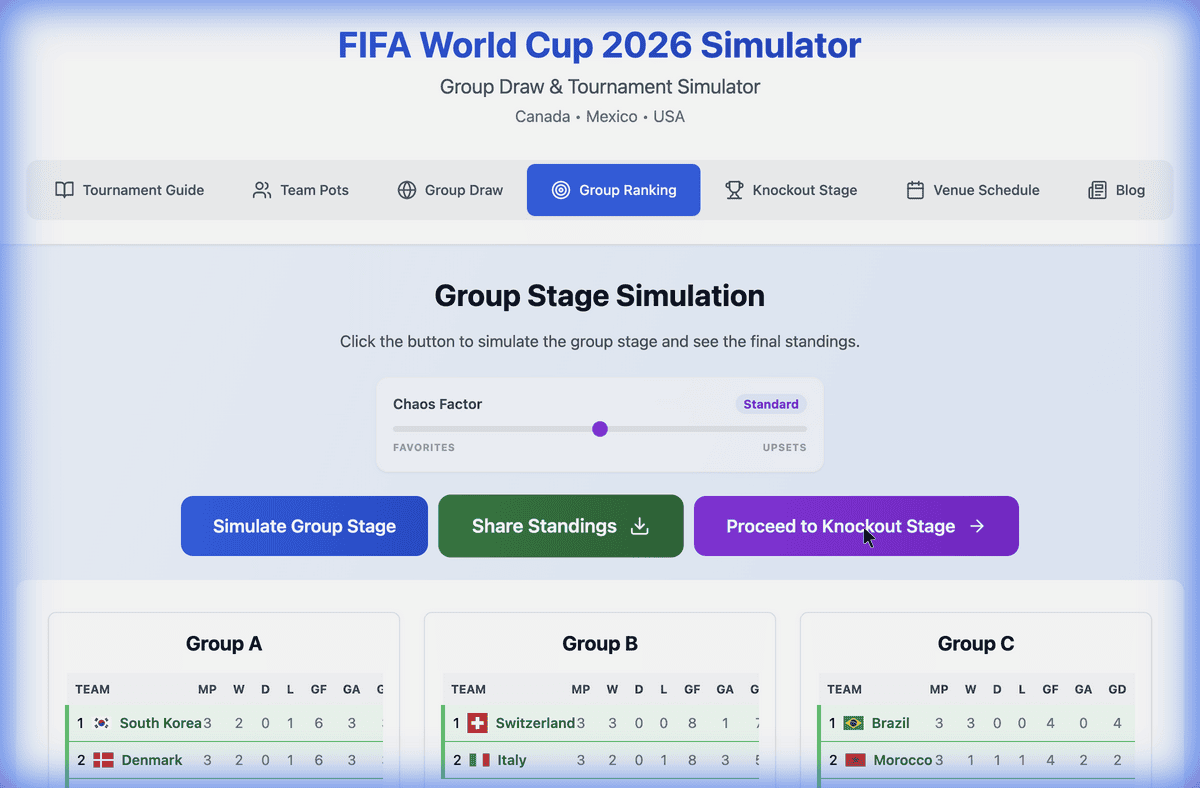
After the simulation, the 12 groups are arranged, ready for your expert analysis.
Beyond the draw: simulation of the entire tournament
Creating your personalized group stage is just the beginning. An excellent simulator seamlessly integrates the draw into the rest of the tournament.
Once your groups are defined, you can move on to the next step. A single click on “Simulate Group Stage” will use an advanced ELO-based model to predict the winner and runner-up of each group, as well as the top 8 third-placed teams who will also advance in the new 48-team format.
From there, the simulator automatically generates the full 32-team knockout bracket. You can then simulate match by match, or the entire table at once, to crown your champion. This transforms the draft simulator from a simple simulation generator into a powerful end-to-end prediction tool.
For a complete walkthrough of this entire process, check out our complete guide on how to use the World Cup simulator.
The Art of “What If”: Exploring Potential Scenarios
While the official draw for the 2026 World Cup group stage has already taken place, setting the actual clashes, the lasting magic of the 2026 World Cup Draw Simulator lies in its ability to explore all the “what if” scenarios. For fans who love to experiment, analyze or simply imagine alternate realities, the simulator offers the unique option to re-simulate the group draws lots as many times as you want. This allows you to go beyond the official result and investigate fascinating hypothetical scenarios.
The Ultimate Group of Death
What is the toughest possible group your team can face? Try running simulations until you get a real nightmare scenario. For example:
- France (Pot 1)
- Germany (hat 2)
- Senegal (Pot 3)
- Italy (hat 4)
A group including three of the last four World Cup winners and the reigning African champions would be pure chaos.
The path of least resistance
Conversely, what is the dream draw for your nation? Simulate until you find a group with favorable matchups that could make it easier to advance to the round of 16.
Host country fortunes
The hosts are ranked, but this does not guarantee an easy journey. Ours Analysis of 100 simulations found that Canada, in particular, faces a high structural risk of attracting a tough European adversary like Italy. Use the simulator to see what types of challenges the United States, Mexico, and Canada are likely to face.
Predicting knockouts
The group draw directly impacts the round of 16 table. Like our Predictions for the round of 16 show, certain groups are destined to cross paths. Use the simulator to see how different group placements can lead to successful Round of 16 matches, like a potential Argentina vs. Uruguay derby.
FAQ: answers to your questions about the World Cup simulator
Q: How accurate are teams and pots in the simulator?
A: The list of 48 teams is based on the latest rankings and qualifying results. As more teams officially qualify, the simulator is updated. For the most up-to-date list, check out our guide on which teams qualified for the 2026 World Cup.
Q: How many times can I run the simulation?
A: As many times as you want! Each click generates a brand new valid draw. Explore at your leisure.
Q: Can I save my favorite print?
A: Although the simulator does not have a “save” function, you can easily take a screenshot of your results to share with your friends or on social media.
Q: Why can’t I have three teams from the same continent in the same group?
A: The simulator strictly follows official FIFA rules, which prohibit teams from the same confederation (except a maximum of two from Europe) from being in the same group in order to guarantee geographical diversity.
It’s your turn to play destiny
THE 2026 World Cup Draw Simulator is more than just a tool; it’s an experience. It’s a tribute to the anticipation, speculation and global conversation that makes the World Cup the greatest spectacle on earth. It puts the power in your hands, allowing you to explore every possible reality on the road to 2026.
So, what are you waiting for? Who will your nation face? Will you create a death band for the ages or a dream path to glory? There’s only one way to find out.
Teknologi Terkini
Agen Togel Terpercaya
Bandar Togel
Sabung Ayam Online
Berita Terkini
Artikel Terbaru
Berita Terbaru
Penerbangan
Berita Politik
Berita Politik
Software
Software Download
Download Aplikasi
Berita Terkini
News
Jasa PBN
Jasa Artikel