The 2026 FIFA World Cup is shaping up to be the biggest global sporting event in history. For the very first time, 48 teams will compete for the ultimate prize, an expansion of the previous format to 32 teams. It brings more nations, more matches and more drama.
But it also brings complexity. With 12 groups, new round of 16 matches and complicated paths to the final, it can be difficult to imagine how the tournament will unfold. How does the new format work? What are the chances of outsider countries? What is the most likely path for your country to win the trophy?
This is where our 48-team World Cup simulator This is a powerful tool designed to help you navigate the new format, simulate the entire tournament draw, and predict the champion.
This comprehensive guide will tell you everything you need to know about the 48-team tournament and how our simulator can bring it to life.
Understanding the new 48-team World Cup format
Before diving into the simulator, it is essential to understand the new tournament structure. The move from 32 to 48 teams fundamentally changed the path to the final.
For a full breakdown, you can read our detailed guide on the World Cup group stage and draw explained. Here is a summary:
- The groups: There is now 12 groups of 4 teams each (groups A to L).
- Advancement: THE two best teams of each group automatically advances to the knockout phase.
- Best third place teams: Here’s the biggest change. THE 8 Best Performing Third Place Teams also qualify for the round of 16. This creates a dramatic “second chance” for teams that narrowly missed out on the top two spots.
- A new knockout round: With 32 teams progressing (24 among the first two + 8 thirds), the tournament introduces a Round of 16. This adds an extra layer of do-or-die matches before the round of 16.
- Total number of matches: The tournament now features a staggering number 104 matchesagainst 64.
This new system opens the door for more countries to participate and dream of glory. But who has the best chances? Let’s simulate it.
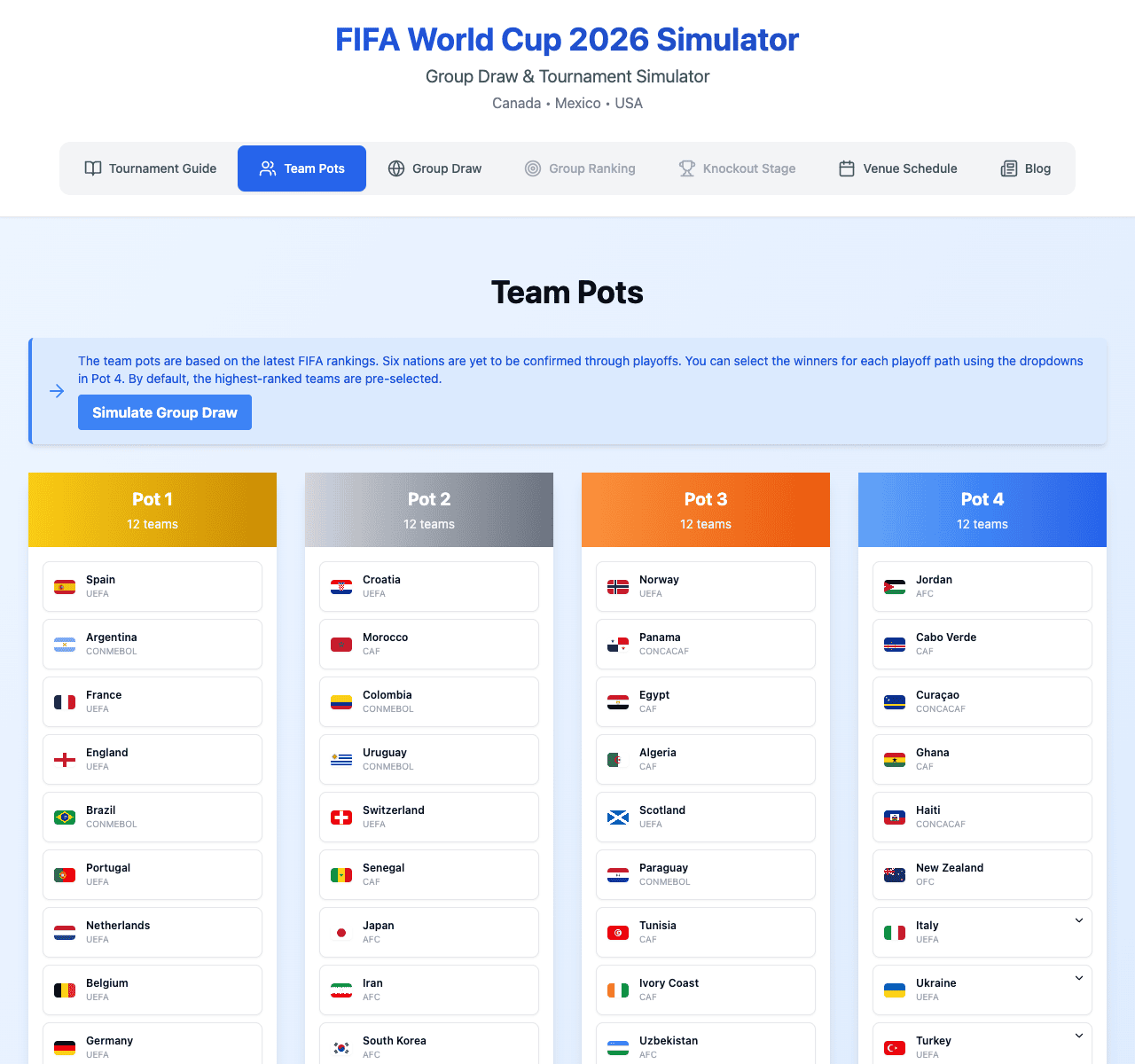
Feature Spotlight: World Cup Draw Simulator
The journey begins with the draw. The fate of 48 nations is decided by the group they land in. Our simulator allows you to proceed to the official draw as many times as you wish.
- Official jars: Teams are divided into pots based on FIFA rankings, just like in real life. The three host nations (United States, Mexico and Canada) are automatically placed in groups.
- Drawing constraints: The simulation respects all the rules of the confederation (for example, no more than two European teams in a group, and no two teams from another confederation in the same group).
- Create your “Group of Death”: Find out what the toughest possible group your team could face looks like. Or, find the dream scenario with a favorable draw.
Don’t hesitate to take control and simulate the official draw yourself. See the groups unfold!
Group stage simulation: who goes out?
Once the draw is complete, the group stage begins. Our 48 team simulator uses an advanced algorithm to play all 72 group matches.
Just click “Simulate the group stage”, and watch the leaderboard update in real time. The simulator calculates the result of each match, determining points, goal difference and goals scored for each team. It then automatically ranks the tables and determines which 32 teams advance.
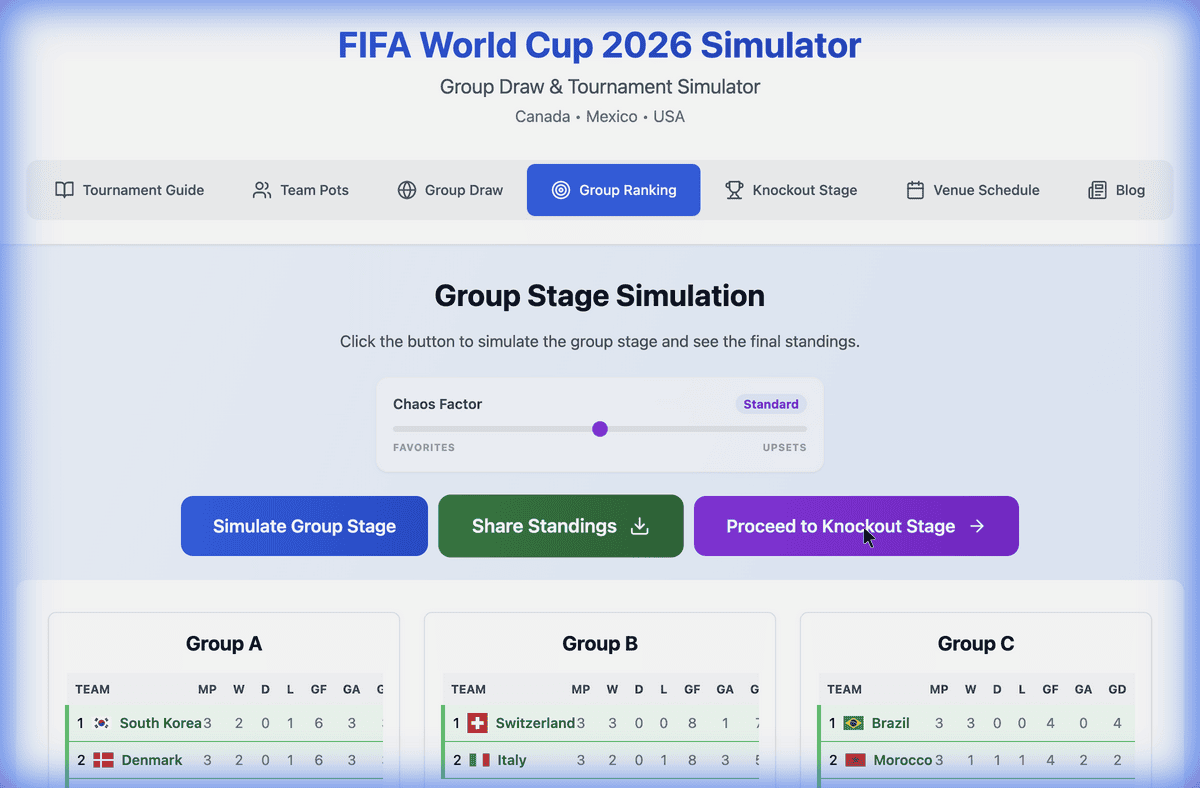
Will your team be at the top of their group? Or will they have to squeeze through the top third-place teams? Each simulation tells a different story.
The Knockout Bracket: a glove for the final
After the simulated group stage, it’s time for the main event: the 32-team knockout bracket. This is where legends are made.
The simulator automatically fills the table based on your results in the group stage. The courses are complex, as group winners are seeded against third-placed teams and runners-up play each other.
You have two options to choose the winner:
- Simulate all matches: In one click, let the simulator replay the entire table, from the round of 16 to the final. See who the computer thinks will be the champion.
- Manual selection: Take control and choose the winner of each match yourself. Guide your favorite team through the table, creating your own perfect World Cup narrative.
This massive group of 32 teams is a sight to behold. Can a courageous outsider pull through, or will traditional powers dominate?
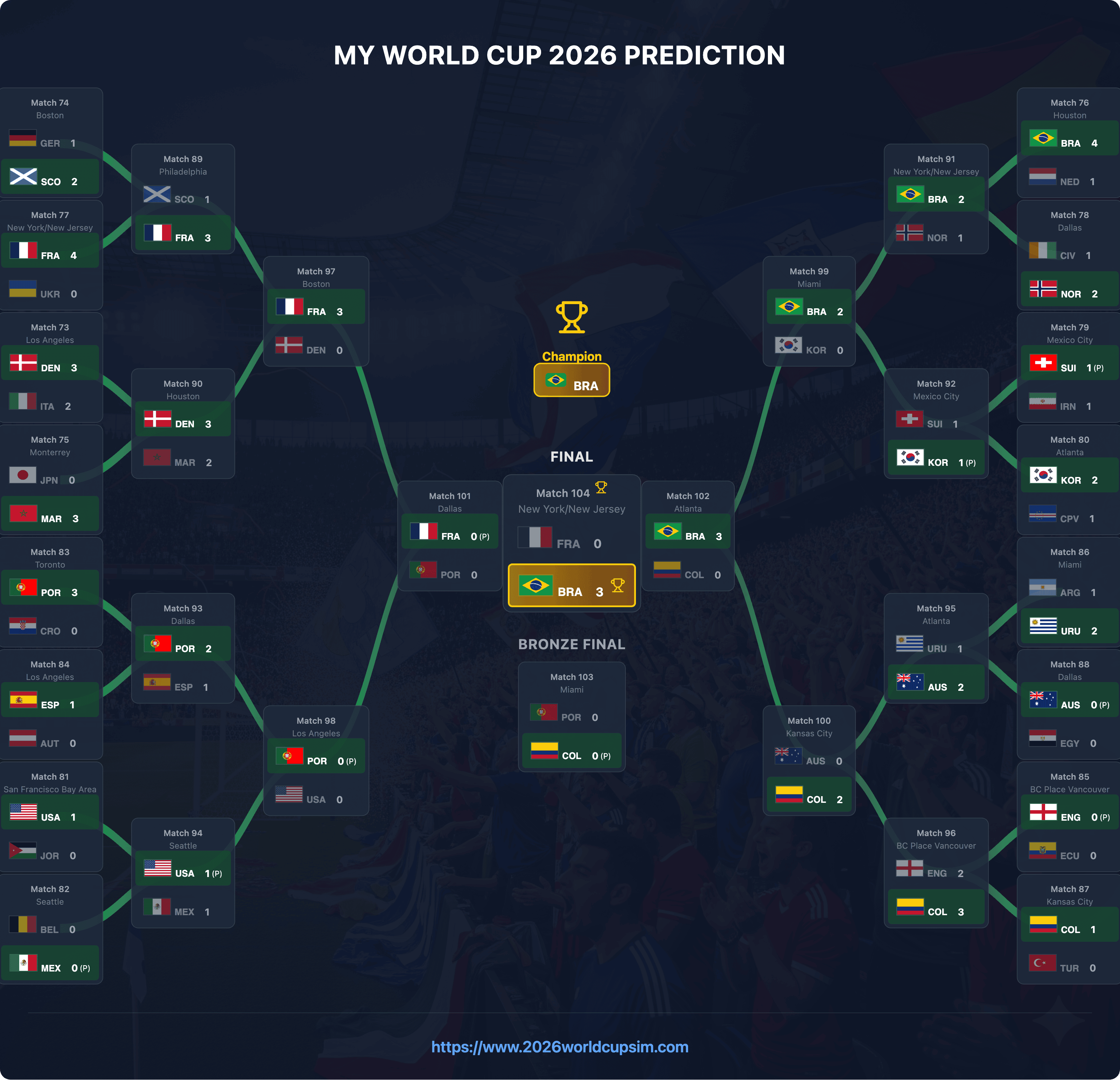
What can you discover with the simulator?
The 48-team World Cup simulator is more than just a prediction tool; it’s a sandbox for football fans to explore endless possibilities.
- Identify potential dark horses: The expanded format gives more opportunities to nations who have never tasted the round of 16. Run simulations to see which lower-ranked teams have the best chance of pulling off a surprise run.
- Analyze your team’s journey: Is your country’s path to the final filled with giants like Brazil and France, or is there a clearer path? The simulator helps you understand the importance of winning the group.
- See the most likely final matchups: After running hundreds of simulations, you will start to see patterns emerge. Which teams regularly reach the final stages? OUR 1000 simulations predict the post-2026 World Cup dives deep into this data.
- Prepare for your Bracket Challenge: Use the simulator to test your theories and refine your predictions before participating in office pools or friendly betting.
More than a simulator: your complete World Cup hub
While predicting the winner is fun, there is so much more to the World Cup experience. Our site is your complete resource for the 2026 tournament.
Conclusion: the future is in your hands
The 2026 FIFA World Cup will be a festival of football like we have never seen. The 48-team format opens a new era of possibilities, where more nations can dream and new rivalries will arise.
There’s no better way to understand the vast, exciting and complex nature of this new tournament than by exploring it yourself. Our simulator is your crystal ball.
So who will you crown champion?
PakarPBN
A Private Blog Network (PBN) is a collection of websites that are controlled by a single individual or organization and used primarily to build backlinks to a “money site” in order to influence its ranking in search engines such as Google. The core idea behind a PBN is based on the importance of backlinks in Google’s ranking algorithm. Since Google views backlinks as signals of authority and trust, some website owners attempt to artificially create these signals through a controlled network of sites.
In a typical PBN setup, the owner acquires expired or aged domains that already have existing authority, backlinks, and history. These domains are rebuilt with new content and hosted separately, often using different IP addresses, hosting providers, themes, and ownership details to make them appear unrelated. Within the content published on these sites, links are strategically placed that point to the main website the owner wants to rank higher. By doing this, the owner attempts to pass link equity (also known as “link juice”) from the PBN sites to the target website.
The purpose of a PBN is to give the impression that the target website is naturally earning links from multiple independent sources. If done effectively, this can temporarily improve keyword rankings, increase organic visibility, and drive more traffic from search results.