The group stage of a FIFA World Cup is a spectacle of global drama, but the knockout stages are where legends are truly made. With the expansion to a 48-team format for 2026, the path to glory is more complex than ever, with new knockout stages. The question on every fan’s mind is: who will my team face if they win or go home?
Although the final draw is still months away, we can project the future. Using our advanced ELO-based simulation model, we ran 100 full tournaments based on a fixed group draw. We didn’t just guess; we used data including the likely winners of the playoff finals (GB, Italy!).
This analysis reveals the statistically most likely pairings for the Round of 16, offering a tantalizing glimpse of the potential matchups that lie ahead. Which titans are on a collision course? Who has the easiest path? Let’s dive into the data.
Want to test the print yourself?
Run your own 2026 World Cup draw simulation!
How does this prediction work?
To understand these results, it is important to know how we obtained them. Our simulation is not random; it is based on each team’s international ELO rankings. We simulated every group stage match 100 times to account for a wide range of outcomes. For undecided playoff spots, we used the default values of Italy, Ukraine, Türkiye, Denmark, DR Congo and Iraq to give the simulation a more realistic edge.
This provides a data-driven prediction of how the group tables will most likely end and, therefore, who is most likely to face whom in the round of 16. For a deeper dive into the mechanics of the tournament, be sure to read our guide to the World Cup group stage and draw format.
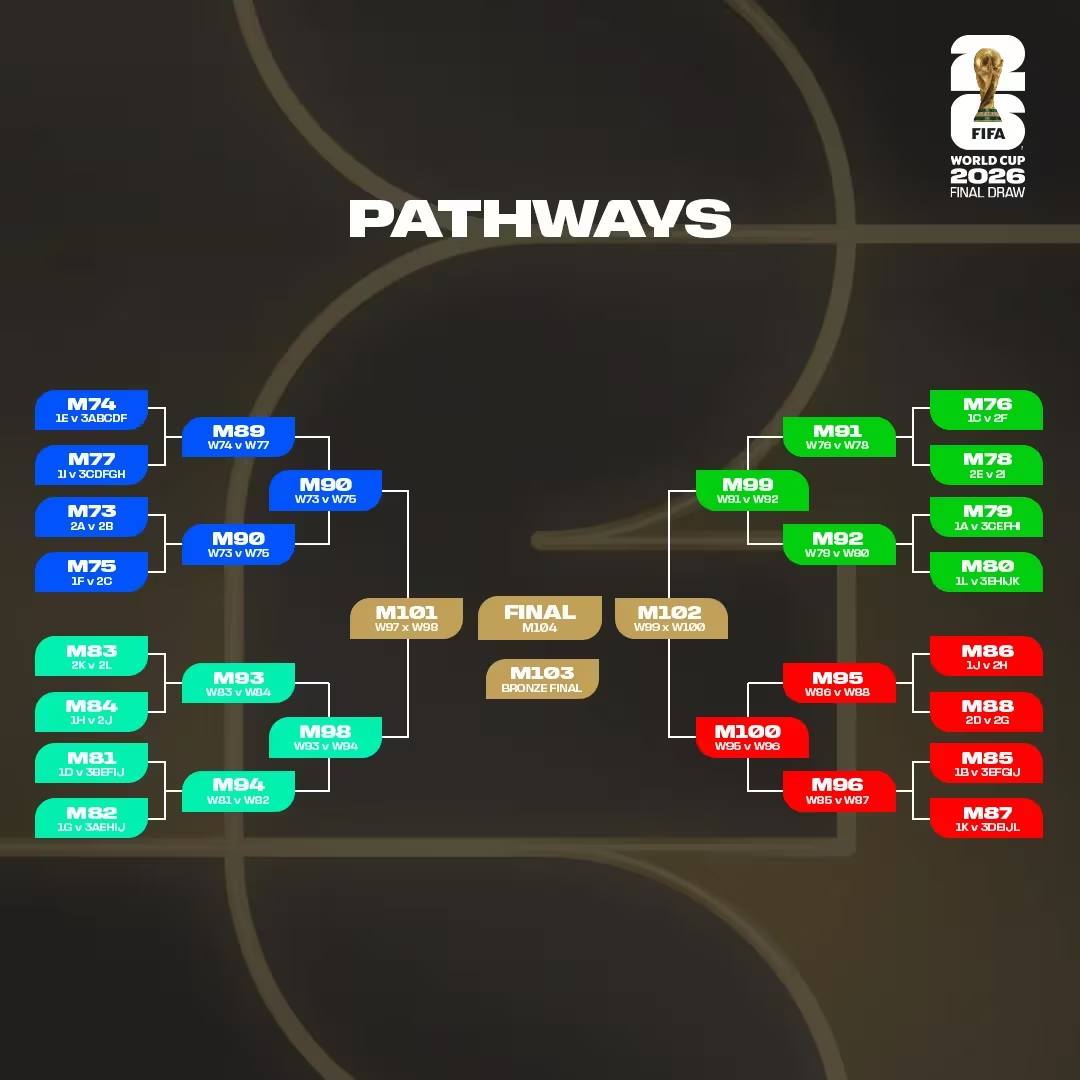
Blockbuster Matchups: Most Likely Rounds of 32 Pairings
After analyzing the numbers from 100 simulations, clear trends emerged. Some matchups appeared much more frequently than others, indicating high-probability matchups dictated by group strength and fixed bracket structure.
A South American classic: Argentina vs. Uruguay (43% probability)
Match ID: M86
The pairing most likely to emerge from all of our simulations is a tantalizing clash between two-time champions Uruguay and defending champions Argentina. This meeting, steeped in history and rivalry, took place in a stunning context. 43 simulations out of 100.
This high probability arises from the predefined range. Argentina are favorites to top Group J, while Uruguay are strong contenders in Group H. The winner of Group J faces the second-place team in Group H in this specific match, making this derby a very real possibility. For fans, this would be a dream knockout match. For the teams, it’s a brutal first test.
European giants on collision course
Several high probability matches involve Europe’s elite, promising tactical battles and intense drama.
- Austria vs Spain (34% probability in M84): Spain, the eternal favorite, has often won its group in our simulations. Their reward? A likely meeting with a very strong Austrian team, which has regularly ranked among the second. This matchup appeared in 34 of our 100 simulations.
- Colombia vs Croatia (33% probability in M83): A fascinating clash of styles. Colombia’s attacking talent versus Croatia’s midfield mastery is a very likely matchup, appearing in a third of all scenarios. This is testament to the consistency of both teams, either winning their group or securing a strong second place finish.
Host countries: the way forward
What about the host countries? Their pre-assigned groups give us a clearer, but no less difficult, picture of their potential adversaries.
The destiny of the United States: a North American derby?
Match ID: M81 and M88
The simulation points to a fascinating, high-stakes path for the USMNT. The United States’ most common opponent was the co-host Canadaduring a successful derby which took place 12 times. This confrontation would attract the attention of the continent.
However, their journey is strewn with pitfalls. Other frequent adversaries include:
- Türkiye (winner of UEFA C qualifiers): A strong European team that would pose a significant tactical challenge.
- Paraguay and Iran: Two robust and disciplined teams who often placed second in their group.
Mexico’s knockout challenge
Match ID: M73 and M82
As the top seed in Group A, Mexico’s reward is a round of 16 place at the iconic Estadio Azteca. Their most likely opponent is Swissa team known for being incredibly difficult to break down in knockout football. This pairing appeared 15 times.
Another common scenario saw Mexico facing UEFA Playoff D winner, Denmark (19 times in a different match)a team with a powerful blend of technical skill and physical power. Both matchups suggest Mexico will have a serious fight on their hands to advance to the knockout stages.
In-depth match analysis
Let’s break down the full list of the most common pairs for each of the 16 Round of 16 matches.
M73 match: Switzerland vs Denmark (19%)
A tight and tactical affair on a European scale.
M74 match: Germany v Scotland (12%)
A classic international match full of passion.
M75 match: Netherlands against Morocco (27%)
A revenge between a potential dark horse and an established power.
M76 match: Brazil vs Japan (22%)
Brazil is heavily favored, but Japan’s technical skills make them a dangerous opponent.
M77 match: France against Ukraine (10%)
The Blues are expected to win their group, setting up a likely clash with the winner of Path B of the UEFA qualifiers.
M78 Match: Ecuador vs. Norway (16%)
Two energetic and rising teams fighting for a place in the round of 16.
M79 match: Algeria against Italy (18%)
The simulation strongly encourages Italy to come out of the playoffs, only to find themselves facing a tough and organized Algerian team.
M80 match: Saudi Arabia vs Denmark (10%)
The Danes’ strength makes them frequent group winners, which sets the stage for this potential clash.
U81 Match: Canada vs. United States (12%)
The flagship North American derby that all fans on the continent are hoping for.
M82 match: Belgium against South Korea (17%)
A match pitting European experience against Asian tenacity.
M83 match: Colombia vs Croatia (33%)
One of the most likely matches of the round, a true 50/50 draw.
M84 match: Austria vs Spain (34%)
Spain will have to do their best to break down a disciplined Austrian team.
M85 match: England against DR Congo (22%)
Our simulation sees England often top their group, winning a likely match against the winner of the first inter-confederation qualifiers.
M86 match: Argentina vs. Uruguay (43%)
The flagship act. The most likely and arguably the most exciting match of the round.
U87 match: Ghana vs Portugal (14%)
A potential rematch of previous group stage encounters, this time with everything on the line.
M88 match: Egypt vs. Türkiye (11%)
A clash between two proud footballing nations, just outside Europe’s traditional elite.
Final Thoughts
The beauty of the World Cup is its unpredictability, but data can shed light on the most likely paths. This simulation shows a round of 16 filled with titanic clashes, intense rivalries and fascinating tactical battles. While teams like Argentina, Spain and Brazil face daunting preliminary tests, host nations like the United States and Canada could find themselves on a collision course for a historic derby.
And if you’re already planning your trip, don’t miss our 2026 World Cup ticket guide for all the latest information on ticket prices.
PakarPBN
A Private Blog Network (PBN) is a collection of websites that are controlled by a single individual or organization and used primarily to build backlinks to a “money site” in order to influence its ranking in search engines such as Google. The core idea behind a PBN is based on the importance of backlinks in Google’s ranking algorithm. Since Google views backlinks as signals of authority and trust, some website owners attempt to artificially create these signals through a controlled network of sites.
In a typical PBN setup, the owner acquires expired or aged domains that already have existing authority, backlinks, and history. These domains are rebuilt with new content and hosted separately, often using different IP addresses, hosting providers, themes, and ownership details to make them appear unrelated. Within the content published on these sites, links are strategically placed that point to the main website the owner wants to rank higher. By doing this, the owner attempts to pass link equity (also known as “link juice”) from the PBN sites to the target website.
The purpose of a PBN is to give the impression that the target website is naturally earning links from multiple independent sources. If done effectively, this can temporarily improve keyword rankings, increase organic visibility, and drive more traffic from search results.