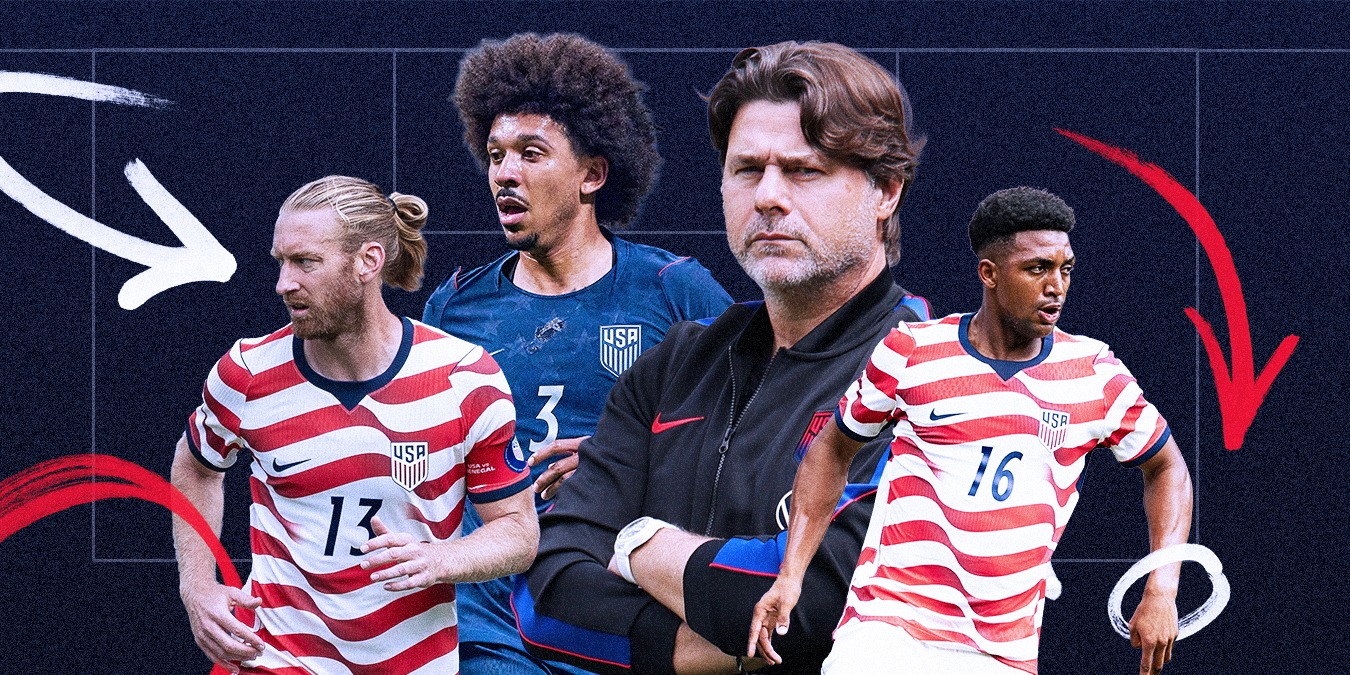
What will the United States’ identity be at the 2026 FIFA World Cup under Mauricio Pochettino? Even as co-hosts and backed to advance from Group D, playing with three at the back seems like the best setup for a deeper tournament run than they’re used to.
The United States men’s national team have started with four at the back for their last 20 World Cup games.
During that time, they have reached the knockout stage in four of the five tournaments they’ve qualified for, with one quarter-final appearance. They’ve come to be seen as a side that shouldn’t be disappointed with reaching the last 16 before bowing out to a team they’re either expected to lose to or is right at their level. The Netherlands in 2022, Belgium in 2014, Ghana in 2010, and Germany in 2002.
Always four at the back, at least on paper. It could be argued the 2014 formation in the last 16 against Belgium featured three centre-backs. Regardless, it is not a formation the Americans have often favoured, in part because – well – sorry if seeing an image of the following starting XI ruins your day if you’re a USMNT fan:
Those of us who are old enough to remember 1998 – and tried to forget it – haven’t exactly been pushing for three at the back since Steve Sampson’s infamous 3-6-1. This is the lineup that started the 1998 World Cup in France, and another back-three iteration ended it with a third straight loss 10 days later. Those of us trying our best to emulate it on our various game consoles and oversized Gateway PCs in FIFA: Road to World Cup 98 had a hell of a time getting the game to understand what we were doing.
A 3-6-1, in other terms, may be a 3-4-2-1 as the graphic above states, which is something current coach Mauricio Pochettino has been experimenting with for the United States’ 2026 squad.
We don’t need to spend a lot of time on why it didn’t work for Sampson or comparing that starting XI to what Pochettino may roll out on 12 June against Paraguay. The game is totally different, and the quality in the U.S. talent pool now compared to 28 years ago isn’t even worth discussing.
But suffice it to say that a back three in 1998 or 2026 is well-suited to working with respectable wing-backs. Sampson’s best, Frankie Hejduk, was on the bench for the start of that tournament. Conversely, Pochettino will play Antonee Robinson and Sergiño Dest outside. They’re two of the players in the U.S. pool who have had the most minutes against quality European competition in their careers, and are two of the certainties for Group D games against Paraguay, Türkiye and Australia.
The question, rather, is whether two or three natural defenders will be covering for them and, as a result of that decision, what the midfield and attack looks like in front of that backline.
Back Three, Back Four, or All of the Above?
The United States aren’t typically favourites to win their group at a World Cup. It can be argued they never have been. Some suggest they are this summer, but the Opta supercomputer currently has them just behind Türkiye (33.3%) to win Group D at 32.1% in perhaps the most wide-open group at the World Cup. It may therefore feel counter-intuitive for them to put three traditional defenders on the pitch, but that seems to be the direction Pochettino is headed – with some potential nuance.

Tim Ream has been named the U.S. captain and is going to play on the left side of that backline with Robinson on the left wing. Chris Richards, if healthy, is an easy centre-back choice, though there’s a chance he’s not recovered from his ankle injury and Mark McKenzie starts against Paraguay.
Where it gets interesting is on the right. If the U.S. do in fact play a back three, Alex Freeman figures to be on the right side of that. Since moving to Villareal in January, Freeman has played all 340 of his minutes as a right back after playing there exclusively in MLS as well.
What that means for their established wing-backs Robinson and Dest, at least judging from their final send-off match on Saturday against Germany, is the symmetry could be a bit different with Dest being in more advanced positions on the right wing than Robinson on the left. This allows them the flexibility of moving between three, four or five defenders.
On paper, that may mean a 3-4-2-1. In practice, there’s the potential for quite a bit of fluidity between a back three or back four. That would mean Dest staying forward, Freeman being wider as a right full-back rather than a right centre-back, Ream and Richards/McKenzie forming a centre-back pairing, and Robinson reverting to left-back in a more traditional back four.
This is part of a larger question of how the United States should attempt to play in this tournament following on from a 2022 showing that was positive in the sense that it passed the eye test but didn’t end in perhaps the advancement that the team or its supporters had hoped for.
In 2022, the U.S. got out of a group that our predictions gave them a 46.8% chance of emerging from. That was in the old 32-team format without any third-place teams advancing, though.
They drew with England and Wales, beat Iran, and then went out in the last 16 to the Netherlands. Observers largely saw it as a positive tournament. It was and it wasn’t. They played optimistic football, but it didn’t result in much in terms of goals. It was enough to get to their usual round-of-16 exit and do so in entertaining fashion, and they did it with a 4-3-3:

Out of possession, you can read that as a 4-2-2-2, 4-4-2 or perhaps still just a 4-3-3. What’s important here is Dest and Robinson were on the outside regardless of how you label it, and it was never a back three that the wing-backs then condensed into a five. Whatever you call it, it wasn’t enough in transition.
In 2022, that formation seemed to work for what they were trying to achieve against England, Iran and Wales – get out of the group and let it ride. They had a slight possession edge over those opponents, they generated more shots (28-19), and they generally played on the front foot:

The U.S. did that without opening themselves up all that much in their first three matches. Their 2.74 xG against in group play was 11th best of the 32-team field. The formation, personnel and style seemed to work – until it didn’t.
Against the Netherlands, they conceded in the 10th minute to a goal that on paper was an extended sequence they should not have been out of position for:

In practice, it played out like a quick transition in which the Dutch took advantage of the space they were afforded by the U.S. midfield and defence. Memphis Depay played out of the defensive half to Cody Gakpo, who carried the ball through the middle of the pitch and played to Denzel Dumfries on the right. Dumfries found a trailing Depay entering the box ahead of Tyler Adams for a one-touch finish. It’s a goal that very well could have been avoided with another defender on the pitch rather than expecting – as the U.S. occasionally do – for Adams to be everywhere.
We’ve had almost exactly eight years to first speculate, and later project, what this team might look like come June 2026. In those first years after hosting was announced, it was easy to say this year would be a great time for players like Christian Pulisic, Weston McKennie and Adams to hit their peaks. But it was eight years away. They’re now all 27, perhaps the age most frequently referenced as an average footballing prime.
While it’s cool to see the core of Pulisic, McKennie and Adams forming the foundation of the team hosting the World Cup, the flip side of that coin is this 2026 team isn’t that different than the 2022 version. It’s still built around a core of Pulisic, McKennie, Adams, Dest and Robinson. There’s a chance this side will start six or seven of that core 2022 group. Which raises the question, despite the hopeful showing in Qatar, of how can the U.S. do better? Putting a very similar team out there and asking them to not be exposed in similar ways against good teams seems a bit wishful. If the core personnel is going to be the same, the formation should probably change.
Three at the back might seem like the conservative approach. We associate it with not losing games rather than going out and winning them. In the context of this U.S. team, we should associate it with finding a way to reach deeper stages of a tournament rather than casting it off as tactical conservatism. Playing a 4-3-3 with this team is asking to do more with arguably less than they had in Qatar.
Gregg Berhalter’s side lost 3-1 to the Dutch, and they allowed inexcusable space for all three of their goals conceded. Overall, Adams had a great tournament. But he’s been injured a lot since, and the centre-back situation behind him isn’t necessarily one that should make anyone think there’s enough quality to avoid the kinds of mistakes that led to their elimination. Ream is almost four years older. Richards was perhaps the surest thing in Poch’s starting XI until he injured his ankle. Teams still find ways to get forward with a back three, and it’s very uncertain this team can adequately defend in transition without one.
It’s oversimplifying things to say three at the back is resigning themselves to pessimistic football. Start by eliminating the inevitability of crippling mistakes. Give the talented outside players the freedom and space to get forward and see what happens. Playing a 4-3-3 seems like the U.S. failing to learn from their defeats.
The Midfield
What made the 2022 U.S. World Cup team a competitive, often enjoyable side to watch was the combination of a capable and synced-up midfield three with a dynamic and talented presence at each full-back position and Pulisic’s involvement in all three goals they scored. It provided balance we didn’t see during the disastrous 2024 Copa America when Dest was injured and the midfield never came close to its World Cup efficacy.
But the USMNT doesn’t have the depth of talent to pick their three most in-form midfielders every four years and expect similar production. What happened in 2022 seemed like it came down to timing – Adams, McKennie and Yunus Musah being somewhere near the top of their games at the same time. While McKennie may now be at the top of his game, Musah isn’t in this squad and Adams has frequently been injured since the 2022 tournament. This raises the question of what to do with the midfield role vacated by Musah.
Playing a back three as outlined above allows them the flexibility of moving between three, four or five defenders, but it also allows them flexibility with the kind of players they put around Adams and McKennie. It could be Timothy Weah as a winger in front of Dest on the right with Pulisic in front of Robinson on the left. Weah started all four matches in 2022.
Or, to get by without starting another wide attacking player like Weah, Malik Tillman or Sebastian Berhalter may slot in next to Adams in midfield as more of a central presence with McKennie playing a more traditional number 10. The latter seems more likely given what Pochettino showed on Saturday against Germany, with Dest in a more advanced role, but it also feels at risk of becoming a 4-3-3 that doesn’t address how a similar team was torched by the Netherlands.
As for playing Tillman/Berhalter rather than Weah, it might make sense to do this to support Adams, but it could also make sense to do it to better establish McKennie’s role as a creator. The Juventus mainstay is coming off his best season with the club and should be in a creative attacking role. His 4,142 minutes across all competitions topped his 2024-25 season by more than 1,000. He scored nine goals, assisted six more and created 71 chances.

The only other Serie A player with 15+ goal involvements and 70+ chances created across all competitions was teammate Kenan Yildiz.
In Attack
The previous main question for the United States men’s national team isn’t the main question this time around. It seems like that question among USMNT supporters entering most major tournaments has been some derivative of: “Who ya playing up top?”
Entering the 2022 tournament, it was a question of Josh Sargent or Jesús Ferreira. This year, Pochettino seems to have settled on Folarin Balogun over Ricardo Pepi and Haji Wright. The U.S. men’s national team, it seems, has a striker in which there is a reasonable amount of confidence rather than a debate about who might be able to poach a goal or two to get them through to the knockout stage.
The choice between the three may ultimately depend on what Pochettino is asking of his striker. If it has been a Balogun vs. Pepi decision, it seems to be a question of whether he’d rather have that striker be able to create opportunities to score, or finish opportunities created for him. Pepi may be more of a clinical finisher, but Balogun is seen as a forward who can do more than get on the end of an opportunity. That might fit more with the likeliest starting XIs.

A front-of-mind concern of playing three at the back is whether there will be less to work with in the attack, so perhaps Balogun makes the most sense for that reason. But going back to the 2022 World Cup, it’s not as if that squad got to where they did by pouring in goals from a 4-3-3. They scored three in four games from 4.09 xG. They were threatening with their wing-backs getting forward, then combining with the likes of McKennie and Pulisic. That can still happen with three at the back.
Perhaps the best example of that was in the 1-0 win over Iran, when they scored following a 31-second sequence:

Dest (2) covered much of the length of the pitch from his involvement in the defensive half at the start of the sequence to his headed assist from inside the penalty area. McKennie was the lynchpin in a central attacking position that connected the dots with a ball into the box. That goal can absolutely happen in a 3-4-2-1 or any of its three-back cousins.
That’s all to say that there seems to be sense in what Pochettino appears to be concocting formationally, even if this seems to be a group that can win with one less defender on the pitch.
It’s easy at this stage to drop platitudes. We’re preparing one game at a time. All that matters right now is getting out of the group. The reality is when you’re hosting a tournament and trying to show the world how you’ve grown as a football nation since hosting in 1994 and advancing to the last 16, it’s not only about getting out of the group and winning a knockout game. It’s about finding a suitable way to play that will also give the United States a chance of advancing through the round of 32 and potentially through the last 16.
Now, 28 years after they last tried, it seems like it’s time to finally make a back-three system work. It’s the most realistic way to do something memorable.

Enjoy this? Add Opta Analyst as a preferred source by clicking here.
Subscribe to our football newsletter to receive exclusive weekly content. You should also follow our social accounts over on X, Instagram, TikTok and Facebook.
PakarPBN
A Private Blog Network (PBN) is a collection of websites that are controlled by a single individual or organization and used primarily to build backlinks to a “money site” in order to influence its ranking in search engines such as Google. The core idea behind a PBN is based on the importance of backlinks in Google’s ranking algorithm. Since Google views backlinks as signals of authority and trust, some website owners attempt to artificially create these signals through a controlled network of sites.
In a typical PBN setup, the owner acquires expired or aged domains that already have existing authority, backlinks, and history. These domains are rebuilt with new content and hosted separately, often using different IP addresses, hosting providers, themes, and ownership details to make them appear unrelated. Within the content published on these sites, links are strategically placed that point to the main website the owner wants to rank higher. By doing this, the owner attempts to pass link equity (also known as “link juice”) from the PBN sites to the target website.
The purpose of a PBN is to give the impression that the target website is naturally earning links from multiple independent sources. If done effectively, this can temporarily improve keyword rankings, increase organic visibility, and drive more traffic from search results.