The final reminder for 2026 FIFA World Cup tickets is upon us. The final draw sales period is officially open, starting on From 11:00 a.m. ET (5:00 p.m. CET) on December 11 to 11:00 a.m. ET (5:00 p.m. CET) on January 13. This isn’t just another queue; it’s your last, best chance to participate in the biggest sporting event on the planet through a lottery-style system.
Unlike the blind faith required in previous rounds, this draw has a significant advantage: the matches in the group stage have been drawn and the price of each match is known in advance. You know exactly which teams are playing, where they’re playing and how much it’s going to cost.
However, this transparency comes with a crucial condition. According to official FIFA guidelines, if you are a lucky candidate, you will be charged a fee. some or all tickets you requested. There is no option to choose the matches you want after the fact. Your credit card will be charged automatically in the days following the draw.
This makes your application strategy more critical than ever. It’s a game of chance, but with the right approach, you can significantly tip the scales in your favor. This guide will walk you through the essential strategies for navigating that final draw, preparing your bid, and maximizing your chances of securing a place at the 2026 World Cup.
The all or nothing draw: a financial commitment
Before you embark on the strategy, it is essential to understand the financial commitment you are making. When you request tickets during this phase, you are entering into a binding agreement. If the draw is successful, FIFA will charge the credit card on file for the full amount of all tickets allocated to you.
This means that you must be prepared to pay for each ticket in your application. Don’t apply for a dozen matches in the hopes of getting one or two. You might get all twelve and you’ll have to pay for them.
To remember: Consider your budget carefully and only apply for matches that you are actually willing and able to attend and afford.
Strategy 1: Category is…higher price, higher probability
One of the most effective strategies for this draw revolves around ticket categories. Although it may seem counterintuitive, requesting a more expensive refund Category 1 tickets often offer a higher probability of success than requesting the cheapest category 2 or category 3 tickets.
Here is the logic:
- Inventory bias: The number of seats available in Category 2 and especially Category 3 is incredibly low compared to Category 1. The vast majority of tickets available to the general public belong to the highest price tier. More tickets mean a bigger pool to draw from, increasing your chances.
- Price disincentive: Prices have increased further for this phase, as detailed in our 2026 World Cup ticket price analysis. These higher prices will naturally deter a segment of candidates from selecting Category 1, leading to less competition for these premium seats.
- FIFA’s economic model: FIFA clearly has an interest in selling its most expensive tickets. By prioritizing candidates who committed at a higher price, they can generate greater revenue.
For many fans, the goal is simply to be in the stadium, regardless of the precise seat location. If your budget allows it, opting for category 1 is a strategic bet that could pay off handsomely.
Strategy 2: Embrace the group stage, beware of knockout dreams
With the group stage matchups set, it’s tempting to look ahead and chart a path to the final. You could imagine a dream round of 16 clash between two titans or hope to catch Messi or Ronaldo in a knockout match.
Yet history and data show that the World Cup is a surprise factory. Betting on specific matchups in the knockout stage is a high-risk bet that often doesn’t pay off.
Just take a look at a recent simulation we ran using ours 2026 World Cup Draw Simulator. The results were anything but predictable.
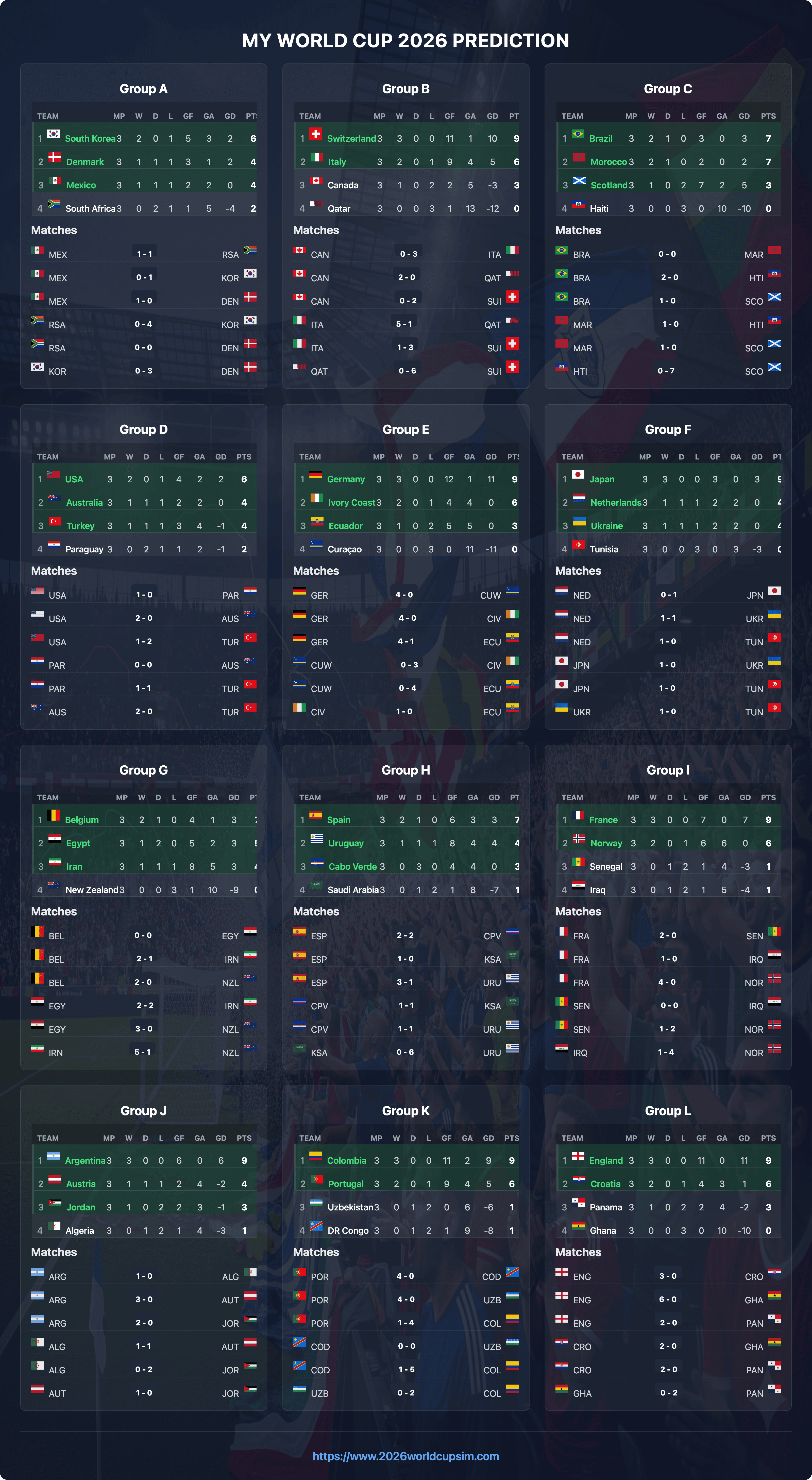
In this simulation, several tournament favorites stumbled:
- Group A: Against all expectations, South Korea finished at the top of the group.
- Group K: Colombia, not heavily favored Portugal, took first place.
These group stage upsets create a domino effect that completely reshuffles the knockout bracket. The dream confrontations that seemed so certain can evaporate in an instant.
Consider the knockout support of this same simulation:
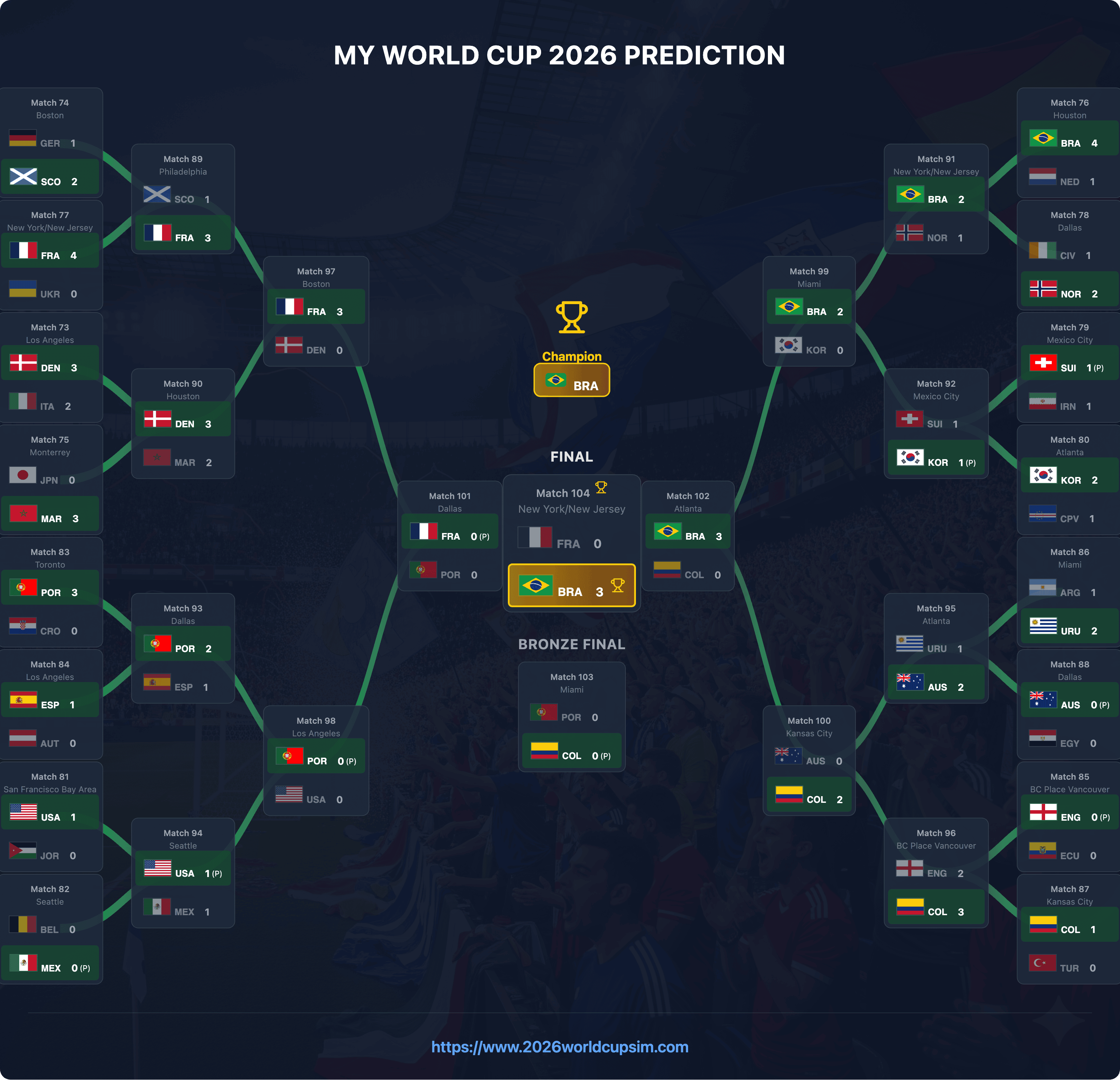
The upheavals continue to pile up:
- Round of 16 (Match 86): Argentina, 2022 world champion, was eliminated by Uruguay.
- Round of 16 (Match 96): England, one of the main contenders for the 2026 title, fell to an impressive Colombian team.
- Quarter-final (Match 100): The match that many fans hoped would be a legendary showdown between Argentina and Portugal (Messi versus Ronaldo) turned out to be Australia versus Colombia.
The lesson is clear: the most predictable matches are the ones that are already set in stone. Focusing your bids on the compelling matchups of the group stage is a much safer bet than banking on the chaotic and unpredictable nature of the knockout rounds.
See the potential chaos for yourself. Use our 2026 World Cup Draw Simulator to explore the millions of possible outcomes and understand how unpredictable the knockout stage can be.
Tying It All Together: Your Application Checklist
As you prepare to submit your application, keep these key strategic pillars in mind:
- Apply, but apply wisely: This is your last chance via the draw. Don’t sit idly by, but be deliberate.
- Check your credit card: Make sure your credit card is valid, has a high enough limit to cover the full cost of your application, and will not expire before the draw results are announced. A failed transaction means lost tickets.
- Prioritize category 1: If your budget allows, selecting Category 1 tickets will give you a statistical advantage over the vast majority of candidates competing for the limited number of Category 2 and 3 seats.
- Focus on the group stage: Apply for known matchups in the group stage. These games are guaranteed to be as expected. For more information on qualified teams, see the official list of qualified teams for the 2026 FIFA World Cup.
The FIFA World Cup is an unforgettable experience. By approaching this final draw with a clear strategy, a realistic budget and an understanding of the odds, you can significantly increase your chances of being part of the action in 2026. Good luck!
PakarPBN
A Private Blog Network (PBN) is a collection of websites that are controlled by a single individual or organization and used primarily to build backlinks to a “money site” in order to influence its ranking in search engines such as Google. The core idea behind a PBN is based on the importance of backlinks in Google’s ranking algorithm. Since Google views backlinks as signals of authority and trust, some website owners attempt to artificially create these signals through a controlled network of sites.
In a typical PBN setup, the owner acquires expired or aged domains that already have existing authority, backlinks, and history. These domains are rebuilt with new content and hosted separately, often using different IP addresses, hosting providers, themes, and ownership details to make them appear unrelated. Within the content published on these sites, links are strategically placed that point to the main website the owner wants to rank higher. By doing this, the owner attempts to pass link equity (also known as “link juice”) from the PBN sites to the target website.
The purpose of a PBN is to give the impression that the target website is naturally earning links from multiple independent sources. If done effectively, this can temporarily improve keyword rankings, increase organic visibility, and drive more traffic from search results.