This is the feature that started it all. Long before the official groups for the 2026 FIFA World Cup were announced, we launched this website with a single aim: to give football fans the opportunity to experience the thrill of the draw for themselves. OUR Group draw simulator was the heart of this project, allowing hundreds of thousands of you to run countless simulations, debate “Groups of Death” and dream of your nation’s path to glory.
Then the official draw took place. With the 12 groups set in stone, we made a logical choice: we removed the simulator and replaced it with a display of the official groups. It seemed like the reasonable thing to do.
We were wrong.
Almost immediately, messages started pouring in. “Where did the draw simulator go? “I loved doing different scenarios!” “Can you please bring it back?” » You told us that even with the official bands known, the magic of the draw – the endless possibilities and “what if” scenarios was something you always wanted to explore.
You asked and we listened. Today we are excited to announce that the original The 2026 World Cup Group Draw Simulator is back and better than ever!
The power of “What if?” »
Why bring back a draw simulator when the real draw has already been done? Because the conversation around the World Cup isn’t just about this Eastbut also what could have been. The beauty of football lies in its endless permutations, and our simulator is the ultimate tool for exploring them.
Fans used it to answer some fascinating questions:
- What if potted seedlings were different? How would the groups change if a team moved up or down in a pot?
- Create the ultimate “Group of Death”: What is the toughest group imaginable based on the 48 qualified teams?
- Simulate a simpler path: What would a dream draw look like for your home country?
- Exploring rival destinies: See what kind of group your biggest rivals might have found themselves in.
- Understanding the process: The simulator is a powerful educational tool that demystifies the complex rules of the World Cup draw.
The official draw is only one version of reality. The simulator gives you the keys to all other possible universes.
How the drawing simulator works: a reminder
For our new fans and for those who need a refresher, our simulator is a detailed recreation of the official FIFA draw process. It adheres to all the complex rules and constraints to ensure that every simulation you run is a plausible outcome.
1. Team drinks
Just like in reality, the 48 qualified teams are divided into four pots according to their FIFA ranking. Pot 1 contains the highest ranked teams and the three host countries (United States, Mexico and Canada), while Pot 4 contains the lowest ranked teams.
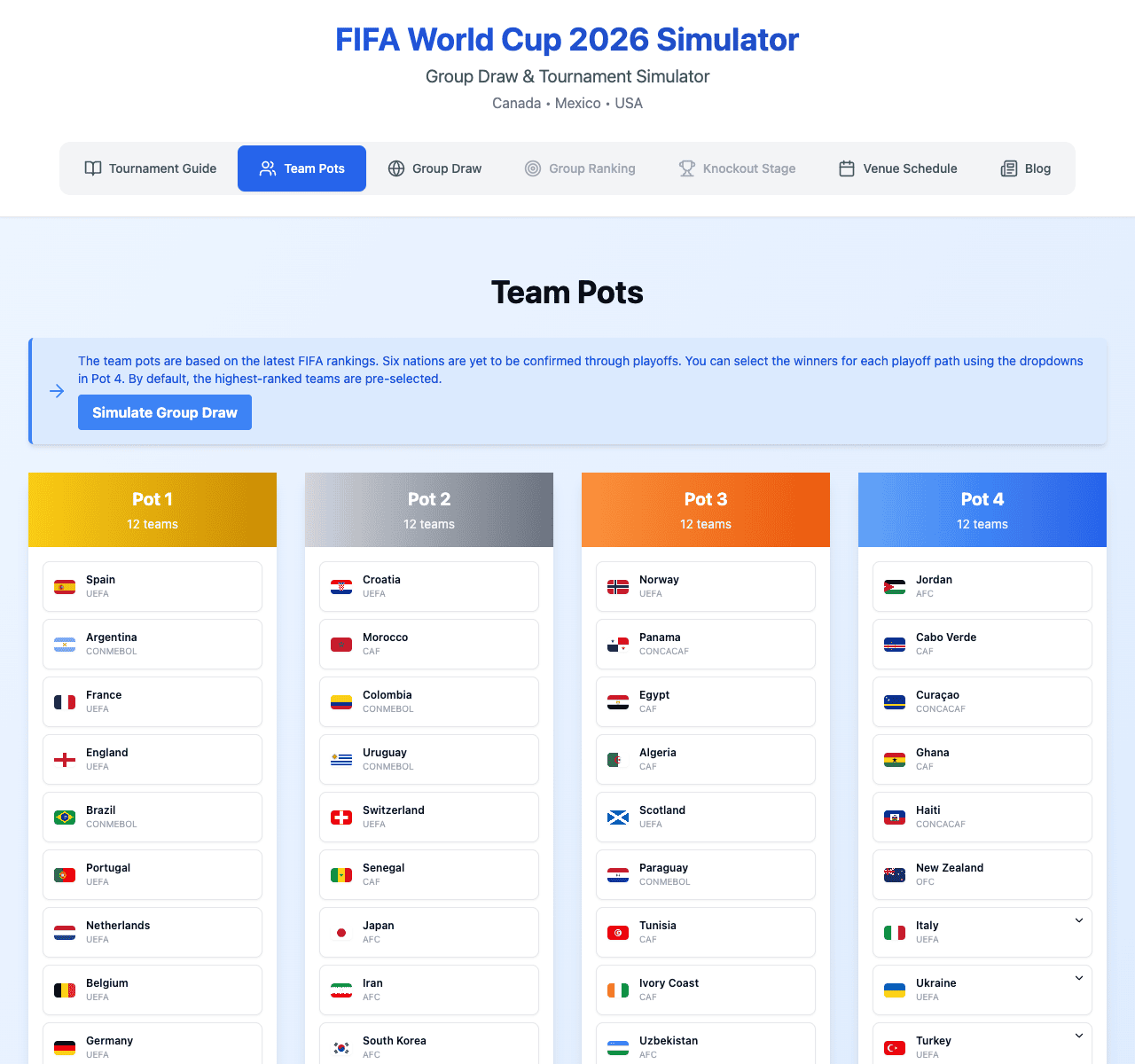
*Teams are divided into four pots based on ranking, forming the basis of the draw.*
2. Drawing constraints
This is where the magic happens. The simulator automatically applies all official FIFA draw constraints:
- Host placement: All three hosts are pre-assigned to specific groups to ensure they will play their group matches at home.
- Confederation clashes: With the exception of Europe, teams from the same confederation cannot be brought together in the same group.
- European limit: A maximum of two European teams can appear in the same group.
Our engine handles all of this in the background, so you can be sure that the groups you generate are fair and realistic. For a deeper dive into the mechanics, you can read our guide to the World Cup group stage and draw process.
From the draw: simulate the entire tournament
The fun doesn’t stop once the groups are drawn. Your personalized print is just the beginning. After simulating your ideal (or most chaotic) group stage, you can move forward.
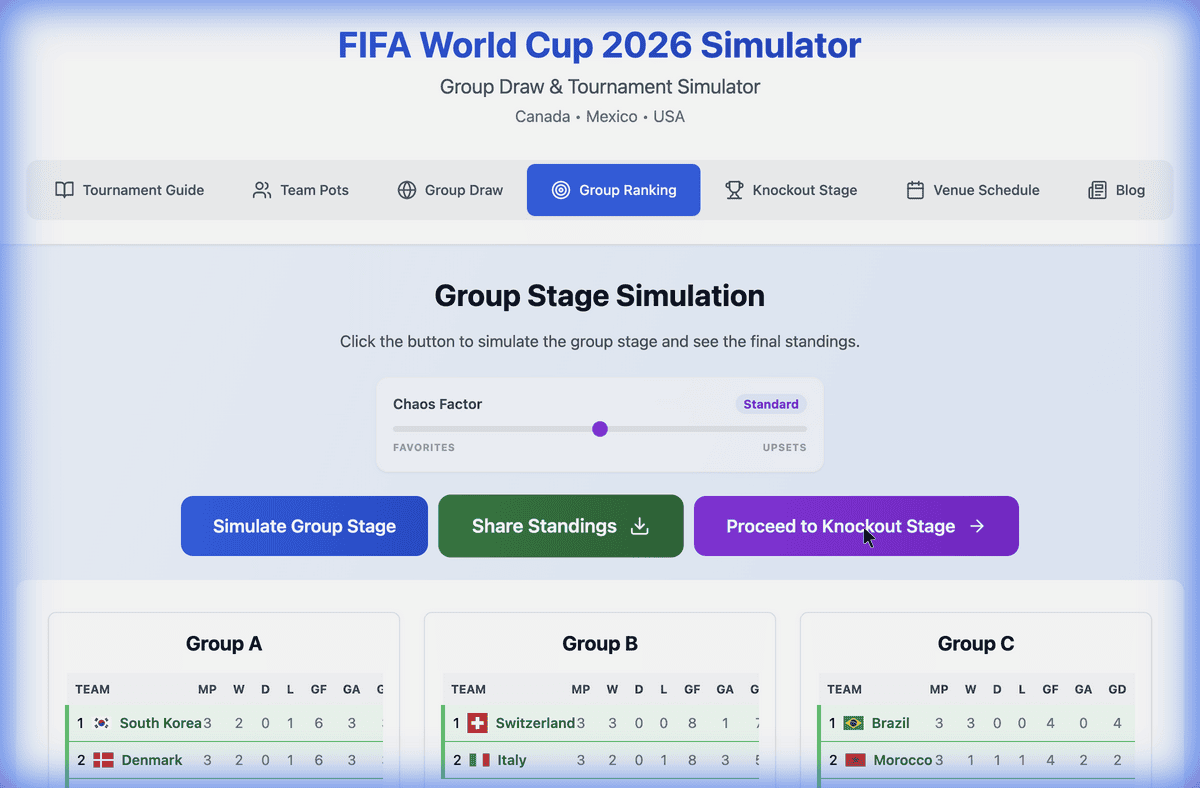
A single click on “Simulate Group Stage” will take you to the group stage simulation based on the groups you just created.
You can then simulate the entire group stage and knockout stage, from the brand new round of 16 all the way to the final, to see which team will emerge as champions in your alternate reality. Who will win the World Cup in a universe where Germany and Brazil are in the same group? Now you can find out.
A tool for every fan
Whether you’re a die-hard football analyst, a casual fan looking to learn more, or someone who simply loves a good simulation, Group Draw Simulator is for you. It’s a tribute to the suspense and excitement that makes the World Cup the greatest sporting event in the world.
We were blown away by the passion of our community and are incredibly excited to bring this feature home. Your feedback truly shapes the future of this platform. For more tips on getting the most out of all our tools, check out our popular article on how to use the World Cup simulator.
Ready to create your own World Cup story?
PakarPBN
A Private Blog Network (PBN) is a collection of websites that are controlled by a single individual or organization and used primarily to build backlinks to a “money site” in order to influence its ranking in search engines such as Google. The core idea behind a PBN is based on the importance of backlinks in Google’s ranking algorithm. Since Google views backlinks as signals of authority and trust, some website owners attempt to artificially create these signals through a controlled network of sites.
In a typical PBN setup, the owner acquires expired or aged domains that already have existing authority, backlinks, and history. These domains are rebuilt with new content and hosted separately, often using different IP addresses, hosting providers, themes, and ownership details to make them appear unrelated. Within the content published on these sites, links are strategically placed that point to the main website the owner wants to rank higher. By doing this, the owner attempts to pass link equity (also known as “link juice”) from the PBN sites to the target website.
The purpose of a PBN is to give the impression that the target website is naturally earning links from multiple independent sources. If done effectively, this can temporarily improve keyword rankings, increase organic visibility, and drive more traffic from search results.