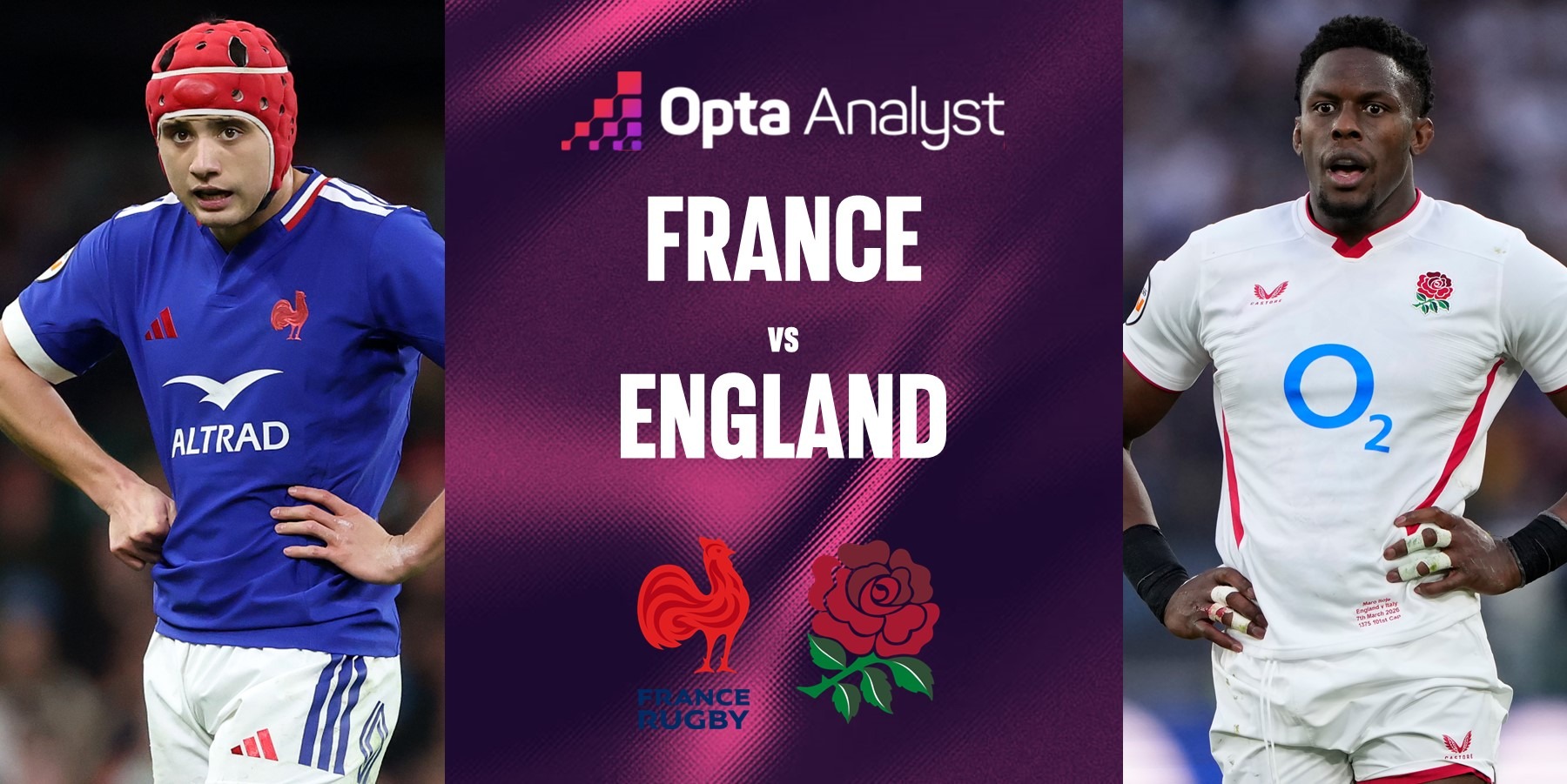
‘The Crunch’ is always a dramatic moment and given the unpredictability of this year’s Six Nations, who knows what could happen at the Stade de France on Saturday night? Our rugby experts provide some answers.
France and England will bring the curtain down on this year’s tournament in Saturday night’s grand final at the Stade de France, with both teams coming into this match on the back of heartbreaking defeats.
However, each team will be highly motivated ahead of the final match – one with glory still in their hands and the other fighting to save their pride.
France have had the upper hand in this match recently, winning five of the last eight Six Nations meetings between the teams, although England won the last death clash. If the visitors repeat this feat, it would be the first time they have recorded consecutive victories against the Blues in the Championship since 2015-2017.
However, France in Paris is a totally different perspective. England have not tasted Six Nations victory in the English Channel since 2016, with France winning four at home against their old foes. However, they have never reached fifth in a row, a piece of history they will be eager to make, but which would only be a footnote rather than a headline if France did enough to win the title.
The Blues have a habit of ending their campaigns on a high, winning their final match in 18 of the last 26 Championships, more than any other nation. A bonus-point victory would all but seal the title in 2026, making it a record eighth Six Nations title in the modern era.
England, for its part, arrived in Paris in crisis. They have lost three matches in a row and are looking at the possibility of four defeats in a Six Nations campaign for the first time since Italy joined the competition – a statistic Steve Borthwick’s side will be desperate to avoid.
Where the game will be won
Despite being at different ends of the table, France and England have similar numbers when it comes to 22 entries.
In attack, France have made 50 incursions into the opposition’s red zone this year, just ahead of England (48), with no other team reaching the 40 mark. It’s a similar story in defense, with England having conceded the fewest 22 entries (29) just ahead of France (31), the next best team being Italy with 37.
However, there couldn’t be a greater contrast when it comes to assessing what happens after these 22 entries.
In attack, the Blues have the best average points per entry (3.3), with only Italy (1.4) having a worse rate than Borthwick’s side (2.0), who have conceded the most points per 22 entries (3.2); The 2.6 points conceded by France for 22 entries corresponds to the overall tournament average.
The battle for set-piece supremacy will be fascinating. England have the best throw-in success rate this campaign (93.9%) while only Ireland (15%) have won possession on more opposition lineouts than these two teams (England 14%, France 13%).
France also have the best scrum success rate this year, winning 91% on their own, but expect England to still chase them in this area – Borthwick’s men have won 14 scrum penalties and conceded just two, both of which combined to be the best of any nation in 2026.
Seven of England’s scrum penalties have come at the opposition’s goal, with Italy (5) the only other team to win more than one.

France vs England Fantastic choices
Louis Bielle-Biarrey is probably the first name on the team sheet on most fantasy teams, but if you’re looking for someone to set your team apart from the rest, look no further than Théo Attissogbe on the other French wing.
Among the players who have participated in more than 5 Six Nations matches, he is the only one to have a better strike rate than Bielle-Biarrey, with an average of 1.2 tries per match (LBB – 1.1). He also contributed three tries and scored seven scores in his six championship appearances.
Eight linebreaks, eight defenders beaten and five offloads this season mean he is likely to score points elsewhere too.

There will be a lot of English players who are very motivated to put in a good performance and end a difficult championship on a high note. Ollie Chessum looks to be a great option, playing on the back row this weekend rather than settling into the engine room.
The back rows are generally better scorers than the second rows, as they can expend a little more energy outside of the set piece, so he could be a nifty pickup, while he will likely still be a nuisance to the lineout – he is comfortably in the lead for lineout catches overall this year and is one of five players to have recorded a tournament-high two lineout interceptions.
France vs England Prediction

Supercomputer Opta sees France’s defeat at Murrayfield last weekend as merely a bump in the road to Six Nations glory, giving them a 79.8% chance of winning, with England having just under a one in five chance (19.3%).
The supercomputer estimates that France will win by more than two scores, with a score of 36-21 the most likely outcome based on the supercomputer’s simulations. Such a score would suggest a high probability that France would secure the bonus points try, which would all but guarantee a second consecutive title.
France vs England Compositions
France: 15 Thomas Ramos, 14 Théo Attissogbe, 13 Pierre-Louis Barassi, 12 Yoram Moefana, 11 Louis Bielle-Biarrey, 10 Matthieu Jalibert, 9 Antoine Dupont, 1 Jean-Baptiste Gros, 2 Julien Marchand, 3 Dorian Aldegheri, 4 Thibaud Flament, 5 Emmanuel Meafou, 6 François Cros, 7 Temo Matiu, 8 Charles Ollivon
Substitutes: 16 Peato Mauvaka, 17 Rodrigue Neti, 18 Demba Bamba, 19 Hugo Auradou, 20 Mickael Guillard, 21 Joshua Brennan, 22 Baptiste Serin, 23 Emilien Gailleton
England: 15 Elliot Daly, 14 Tom Roebuck, 13 Tommy Freeman, 12 Seb Atkinson, 11 Cadan Murley, 10 Fin Smith, 9 Ben Spencer, 1 Ellis Genge, 2 Jamie George, 3 Joe Heyes, 4 Maro Itoje, 5 Alex Coles, 6 Ollie Chessum, 7 Guy Pepper, 8 Ben Earl
Substitutes: 16 Luke Cowan-Dickie, 17 Bevan Rodd, 18 Trevor Davison, 19 Chandler Cunningham-South, 20 Sam Underhill, 21 Henry Pollock, 22 Jack van Poortvliet, 23 Marcus Smith
Ccheck out our other Rugby Union content on Opta Analyst. You can also follow our social accounts on XInstagram, TikTok and Facebook.
PakarPBN
A Private Blog Network (PBN) is a collection of websites that are controlled by a single individual or organization and used primarily to build backlinks to a “money site” in order to influence its ranking in search engines such as Google. The core idea behind a PBN is based on the importance of backlinks in Google’s ranking algorithm. Since Google views backlinks as signals of authority and trust, some website owners attempt to artificially create these signals through a controlled network of sites.
In a typical PBN setup, the owner acquires expired or aged domains that already have existing authority, backlinks, and history. These domains are rebuilt with new content and hosted separately, often using different IP addresses, hosting providers, themes, and ownership details to make them appear unrelated. Within the content published on these sites, links are strategically placed that point to the main website the owner wants to rank higher. By doing this, the owner attempts to pass link equity (also known as “link juice”) from the PBN sites to the target website.
The purpose of a PBN is to give the impression that the target website is naturally earning links from multiple independent sources. If done effectively, this can temporarily improve keyword rankings, increase organic visibility, and drive more traffic from search results.